-108px-wide-for-website.png)

Emergency Preparedness for Vacation Rentals: Communication When It Matters Most
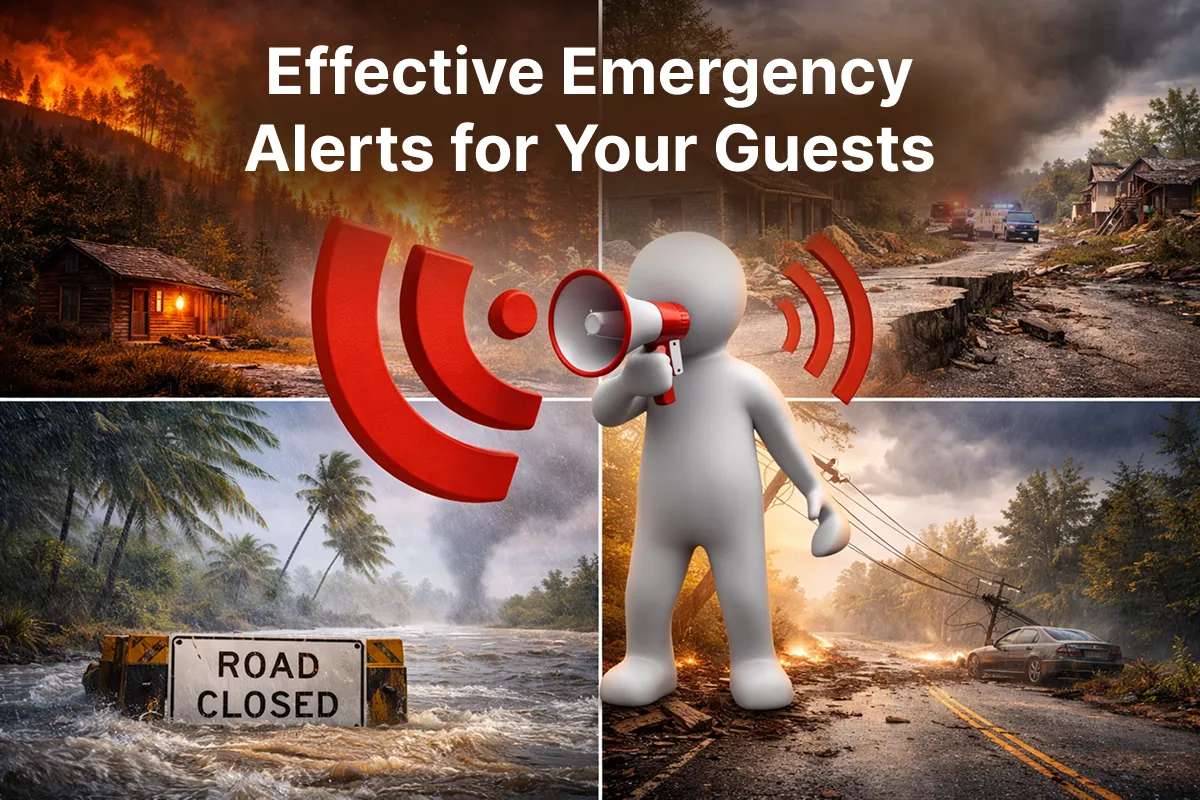
Emergency preparedness is becoming a bigger issue for short-term rental hosts, especially in wildfire-prone, coastal, mountain, and rural markets.
Most hosts think about the obvious basics: smoke detectors, carbon monoxide alarms, fire extinguishers, and a first aid kit. Those are essential. But in a real emergency, one of the most important questions is often overlooked:
How will you quickly reach the guests who are actually inside the property?
That question matters during wildfires, evacuations, road closures, flooding, power outages, winter storms, severe wind events, earthquakes, and other emergencies that can develop quickly. For vacation rental guests, the property is unfamiliar. They may not know the address, the safest route out, where supplies are located, or who to contact first.
That makes emergency guest communication a critical part of any short-term rental emergency plan.
The Problem With Relying Only on OTA Messaging
Many vacation rental guests book through platforms like Airbnb and Vrbo. Those platforms are useful for reservation communication, but OTA messaging is not designed to be the only emergency communication channel.
In many cases, only the booking guest receives the message. Other people staying in the home may never see it. Even the booking guest may have app notifications muted, poor cell service, a dead phone battery, or simply may not be checking the app at the moment the message arrives.
That may be acceptable for routine guest communication.
It is not ideal when there is a wildfire evacuation, a road closure, a power outage, or an urgent safety concern.
In an emergency, hosts and property managers need a way to reach guests quickly, clearly, and repeatedly — preferably through more than one channel.
Emergency Preparedness Starts With Clear Instructions
A strong vacation rental emergency plan should include the basics:
- Clear evacuation instructions
- Local emergency numbers
- The property address displayed prominently
- Instructions for fire, carbon monoxide, severe weather, flooding, or other local risks
- Backup plans for power, water, heat, road access, or communication failures
- First aid supplies and visible safety equipment
- Documentation procedures for damage, insurance, and guest support
Those items should be included in a printed guide, digital guidebook, and pre-arrival information when appropriate.
But written instructions are only part of the solution.
When something is happening right now, guests need a message that gets their attention immediately.
Introducing AIPEX Emergency Alerts
AIPEX helps hosts and property managers communicate with guests directly through in-property smart display devices.
That already gives hosts an important advantage: communication is no longer limited to the booking guest’s phone or an OTA app. Messages can be delivered inside the property, where the guests are staying.
With the new AIPEX Emergency Alert capability, hosts can choose how a real-time message should be delivered:
- Notification – The device alerts the guest that a message is waiting.
- Announcement – Alexa speaks the message aloud.
- Emergency Alert – Alexa audibly announces the emergency message at maximum volume and repeats it every five minutes for up to two hours.
That makes AIPEX Emergency Alerts especially useful for urgent guest communication during events such as:
- Wildfire evacuation notices
- Flash flooding or road closures
- Severe windstorms or downed power lines
- Anticipated power outages
- Earthquakes or aftershocks
- Winter storms or access issues
- Other local safety events
Emergency Alerts are designed for situations where a standard message may not be enough.
What Hosts Can Say in an Emergency Alert
The message does not need to be complicated. In fact, shorter is usually better.
Hosts can use the alert to provide direct instructions:
“Emergency alert. Evacuate now. Use the north exit route toward Highway 20. Do not use Lakeside Road. Call us immediately at 555-123-4567.”
Or, if details are changing quickly, the host can use the alert to get the guest’s attention and establish direct contact:
“Emergency alert. There is an urgent safety situation in the area. Please call or text us immediately at 555-123-4567 for instructions.”
Both approaches can be useful. The right choice depends on the situation, the level of certainty, and whether local officials have issued specific instructions.
AIPEX Is One Part of a Bigger Emergency Plan
AIPEX Emergency Alerts are not a replacement for full emergency preparedness. Hosts still need working safety equipment, clear evacuation routes, local hazard planning, reliable property documentation, and well-maintained physical infrastructure.
But communication is one of the most important parts of that plan.
If guests do not receive the message, even the best emergency instructions may not help.
That is where AIPEX can make a meaningful difference. By delivering urgent messages directly inside the property, AIPEX gives hosts another way to reach guests quickly — especially when OTA messaging, mobile apps, or cell phones may not be enough.
For short-term rental operators in wildfire zones, coastal markets, rural destinations, mountain communities, and other higher-risk locations, this kind of in-property guest communication can be a valuable part of a more complete emergency preparedness strategy.
Because when minutes matter, getting the message to guests matters.
.jpg)